

Egyptian Civilisation Timeline
Factsheet: A brief timeline of Egyptian civilisation
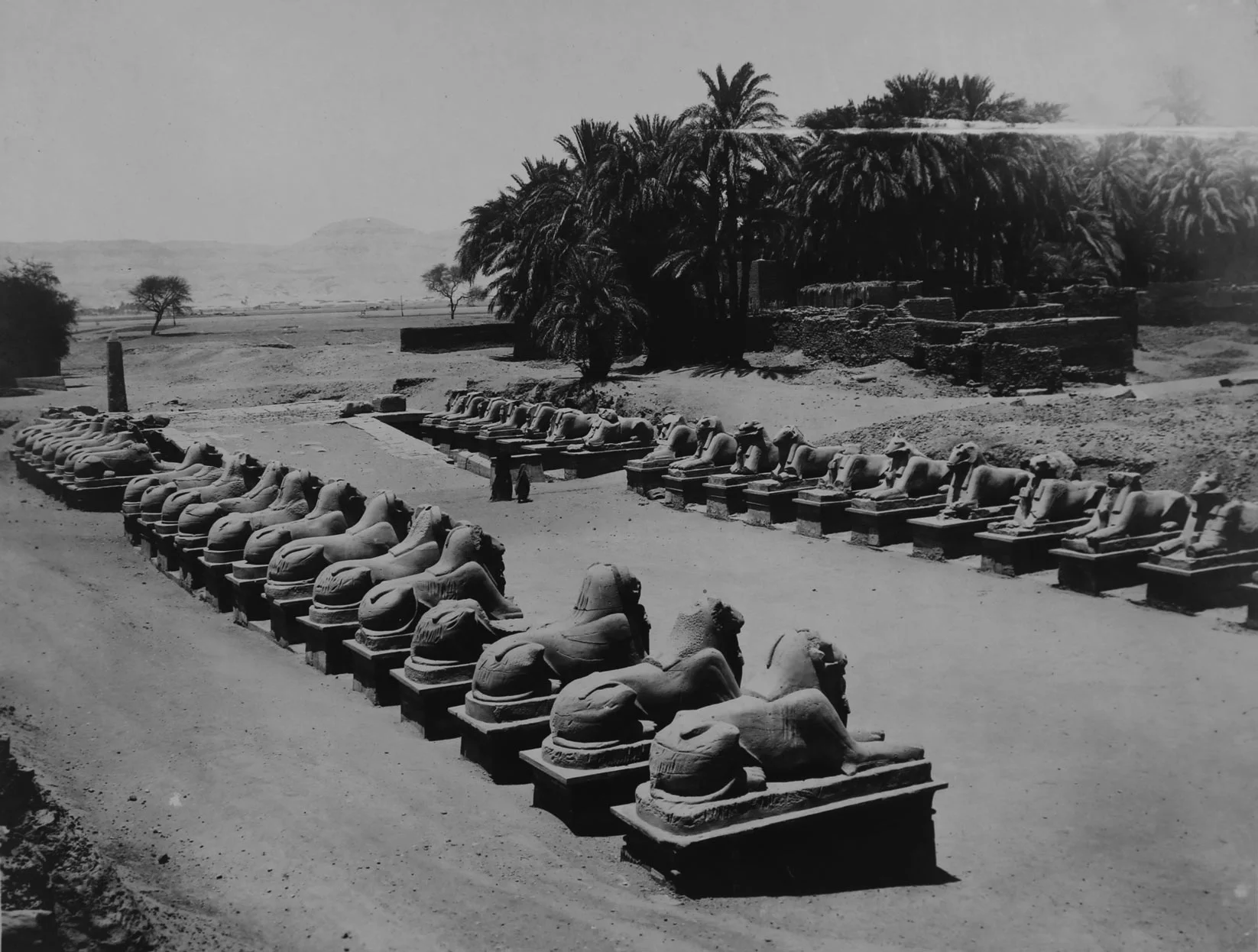
Rows of sphinx at Karnak, image from the Kovar Collection, auctioned 2014.
BC
c. 7000 – Settlement of Nile Valley begins
c. 5000 – Coming of farming to the Nile Valley
c. 3500 – Pre-dynastic period begins
c. 3000 – Unification of Egypt
c. 3100 – Hieroglyphic script developed
c. 2650 – Beginning of the Old Kingdom; First stone pyramid built: the Step Pyramid, at Saqqara for the pharaoh Djoser
c. 2575-2465 – The Great Pyramids of Giza built
c. 2150 – Fall of the Old Kingdom, leading to the 1st Intermediate period
2074 – Middle Kingdom begins; Egypt is united and powerful again
1759 – Fall of the Middle Kingdom, leading to 2nd Intermediate period; Occupation of northern Egypt by the Hyksos
1539 – Reunification of Egypt and the expulsion of the Hyksos begins the New Kingdom; Egypt becomes a leading power in the Middle East
1344-1328 – The pharaoh Akhenaton carries out a short-lived religious reformation
1336-1327 – Tutankhamen reigns
1279-1213 – Reign of Ramses II brings Egypt to the height of its power
c. 1150 – The New Kingdom begins its decline
728 – Egypt is conquered by Nubian kings
c. 671 – Egypt is occupied by the Assyrians
639 – Egyptians expel the Assyrians and begin a period of revival
525 – Egypt is conquered by the Persians
332 – Alexander the Great, of ancient Macedonia, conquers Egypt, founds Alexandria; Macedonian dynasty rules until 31 BC
305 – Ptolemy, one of Alexander the Great's generals, founds a Greek-speaking dynasty
196 – Rosetta Stone carved
30 – Cleopatra, the last queen of independent Egypt in ancient times, dies; Egypt is annexed by the Roman Empire
AD
33 AD – Christianity comes to Egypt
c. 350 – Last use of hieroglyphic writing
642 – Arab conquest of Egypt
969 – Cairo established as capital
1250-1517 – Mameluke (slave soldier) rule, characterised by prosperity and well-ordered civic institutions
1517 – Egypt absorbed into the Turkish Ottoman empire
1798 – Napoleon invades but is repelled by the British and the Turks in 1801
1805 – Ottoman Albanian commander Muhammad Ali establishes a dynasty; It rules until 1952, although is nominally part of the Ottoman Empire
1859-69 – Suez Canal built leading to the near-bankrupting Egypt and British takeover
1882 – British troops defeat Egyptian army and take control of the country; Hieroglyphs deciphered
1914 – Egypt formally becomes a British protectorate
1922 – Fuad I becomes King and Egypt gains independence
1922 – Howard Carter discovered the tomb of Tutankhamun
1953 – Egypt became independent
Note: Dates in this timeline are estimates due to the age of some of the events.

Collector's Notebook: Shabti Figures
It is beleived that Shabti figures developed from the servant figures common in tombs of the Middle Kingdom. They were shown mummified, like the deceased, with their own coffin and were inscribed with a spell to provide food for their master or mistress in the afterlife.
It is believed that Shabti figures developed from the servant figures common in tombs of the Middle Kingdom. They were shown mummified, like the deceased, with their own coffin and were inscribed with a spell to provide food for their master or mistress in the afterlife.
From the New Kingdom (circa 1550-1070 B.C.) onwards, it was believed the deceased would live for eternity in the ‘Field of Reeds’, and so they were expected to assist with its’ maintenance. Such work included agricultural labours, ploughing, sowing, and reaping the crops. Understandably, the deceased were keen not to personally undertake this work throughout eternity, so the Shabti figure was created as a servant that would carry out heavy work on their behalf. The mummiform figures held agricultural implements such as hoes. To ensure the deceased would not be called upon for manual labor, the Shabti’s were inscribed with a spell which ensured they answered when the deceased was called to work – hence the name ‘Shabti’ (meaning ‘answerer’).
From the end of the New Kingdom, anyone who could afford to do so might have a total of 401 figures – one for every day of the year, with an overseer figure for each group of ten labourers. Many individuals had several sets. These vast collections were often of extremely poor quality, uninscribed and made of mud rather than faïence, which had been often used in the New Kingdom.

AN EGYPTIAN PALE AZURE GLAZED FAÏENCE SHABTI, Late Period, Circa 600-300 B.C., 12.5cm