

Gandhara, Aristotle and Alexander the Great
Although ruthless in battle and in the habit of annihilating the armies and rulers he defeated, Alexander did not force his culture on inhabitants of the regions he conquered. Instead he fostered longer-lasting natural bonds through dialogue and by encouraging inter-cultural marriages, which very effectively stabilised the regions socioculturally.
The Kingdom of Gandhara was a cosmopolitan culture much like the earlier Indus Valley civilisations and was located at the intersection of what is now north-west Pakistan and north east Afghanistan on the prosperous Silk Road.
The art we now prize so highly from this kingdom is defined by its fine sculptural detail, beauty and serenity. But what were the foundations of this style? To find out we have to look to Alexander the Great.
Much of the beauty of Gandharan art arises from its Greco-Buddhist blend that is a legacy of Alexander the Great who in 327 BC, at the age of 29, conquered the Achaemenid Empire – laying waste to the great armies of the Persian King Darius III who was at the time arguably the most feared ruler of the then know world. Alexander’s empire at this time was so vast it stretched from the Adriatic Sea to the Indus River.
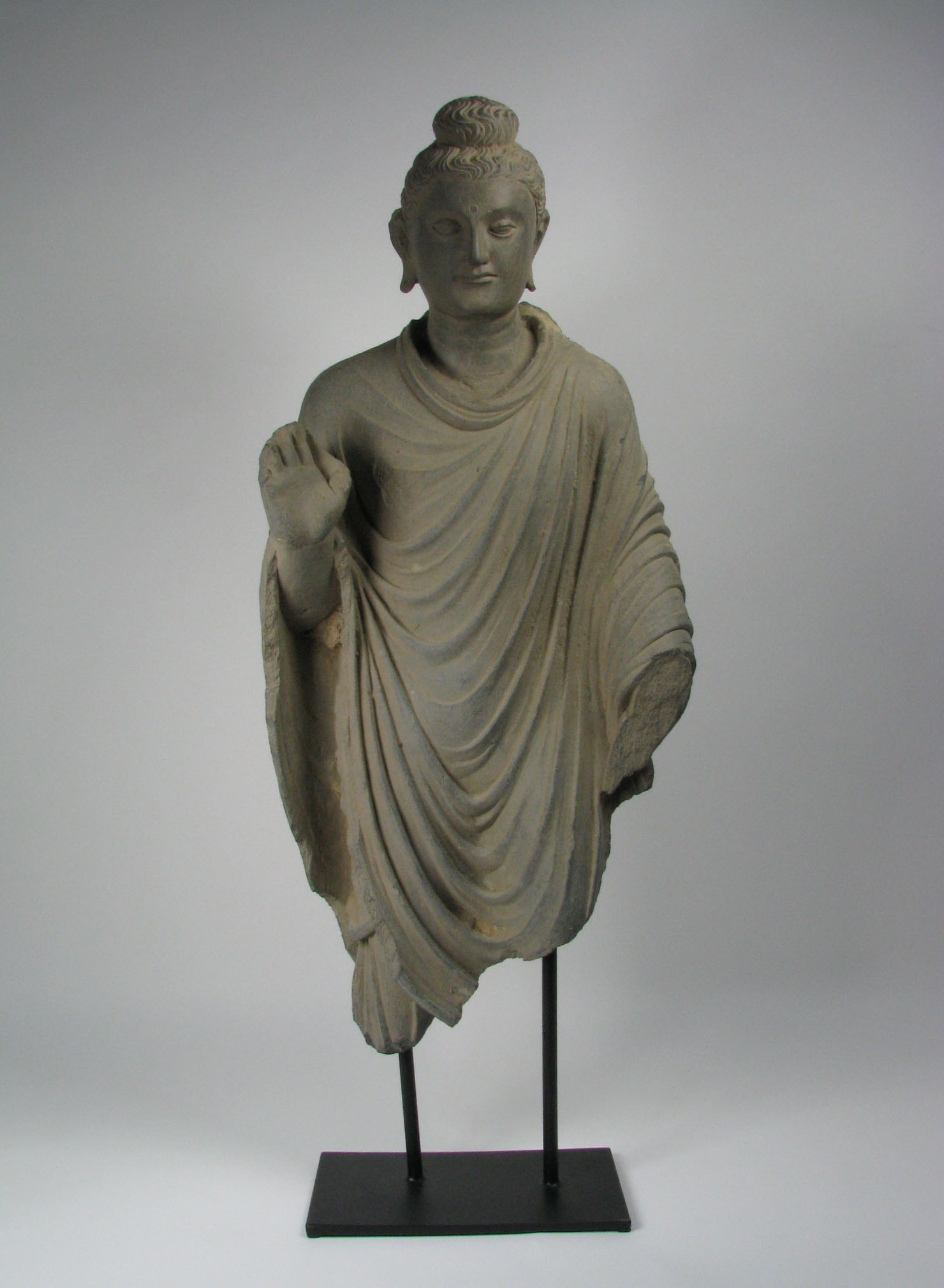
A Gandharan Schist Sculpture Of Buddha, c. 3rd Century AD, dressed in a long flowing robe, the visage of fine features and benign expression with wavy hair pulled up and tied in a topknot, (75x35cm). Sold at one of our past auctions A$15,000
Gandharan sculpture's appeal arises from the unusual combination of Buddhism being blended with Grecian style. That the combining of these two cultures resulted in works of such beauty may be linked to Alexander’s fundamentally Aristotelian approach to law and order of the various regions he conquered and the diverse sociocultural environments now under his control.
As a young boy of 14, Alexander’s tutor was Aristotle and they continued to correspond at various times throughout Alexander’s life. Aristotle’s approach was to introduce an idea to someone rather than force it upon them.
Although ruthless in battle and in the habit of annihilating the armies and rulers he defeated, Alexander did not force his culture on inhabitants of the regions he conquered. Instead he fostered longer-lasting natural bonds through dialogue and by encouraging inter-cultural marriages, which very effectively stabilised the regions socioculturally.
The result of the blend rather than the clash of cultures we can see in the serene Gandharan sculpture of the period such as the work depicted above. This became a unique Gandharan style and a clear departure from the region’s traditional Buddhist sculpture. In earlier depictions, the Buddha appeared through symbols only. Now he took a human form and the sculptures were more personal, often depicting episodes of the Buddha’s life and teachings.
Main image: A Gandharan Schist Frieze (c.2nd-3rd Century AD), sculpted in relief with a central Buddha within a pillared arch way (36x54cm). Sold: at one of our past auctions A$10,000
Collector's Notebook: The Indus Valley
Dating from c.6th millennium BC on the Northwest frontier of India, lies the Indus Valley, home to one of the three Old World civilisations, the other two of which were Egypt and Mesopotamia.
Dating from c.6th millennium BC on the Northwest frontier of India, lies the Indus Valley, home to one of the three Old World civilisations, the other two of which were Egypt and Mesopotamia. Covering an area of 800,000 square kilometres, and with up to 5 million inhabitants, it was the most widespread of these three civilisations and was located along two of the great rivers of Asia, the Indus and, the now dry, Sarasvati.
Archaeologists including MS Vats, in the 1920s and Mortimer Wheeler in the 1940s, have identified over 1000 towns, only about 100 of which have been excavated to date. Larger urban centres such as Harappa, located in what is now Punjab in Pakistan, contained grand public architecture and given the complexity of planning, there was clearly an administrative structure to the society that built structures such as dockyards, granaries, warehouses, and protective city walls. However, quite unlike in the other two Old World civilisations, the architecture of the region seems to have been far more functional, as they appear not to have built large monumental structures – such as the pyramids.
As well as the urban structures, other aspects of the Indus civilisation would have been extremely familiar to us in the 21st century, particularly that they were one of the first civilisations to develop a uniform system of weights and measures, with weight based on a metric system.
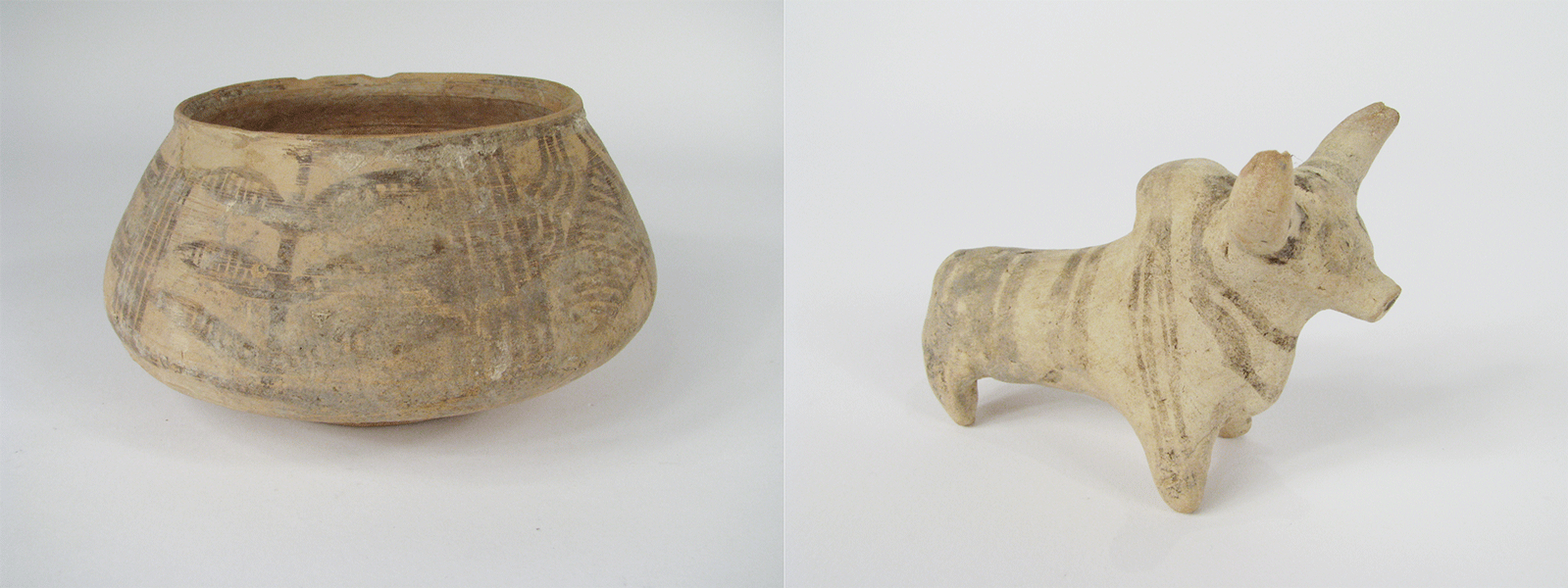
One of the more familiar artefacts found in the region is the fine-grained earthenware pottery. This was ochre-coloured and often highly decorated, usually with black outlines, then sometimes with an in-fill of red, yellow, white, and blue pigment. The patterns were often geometric and depicted a variety of animals including fish, birds, cows, goats, antelopes, and lions.
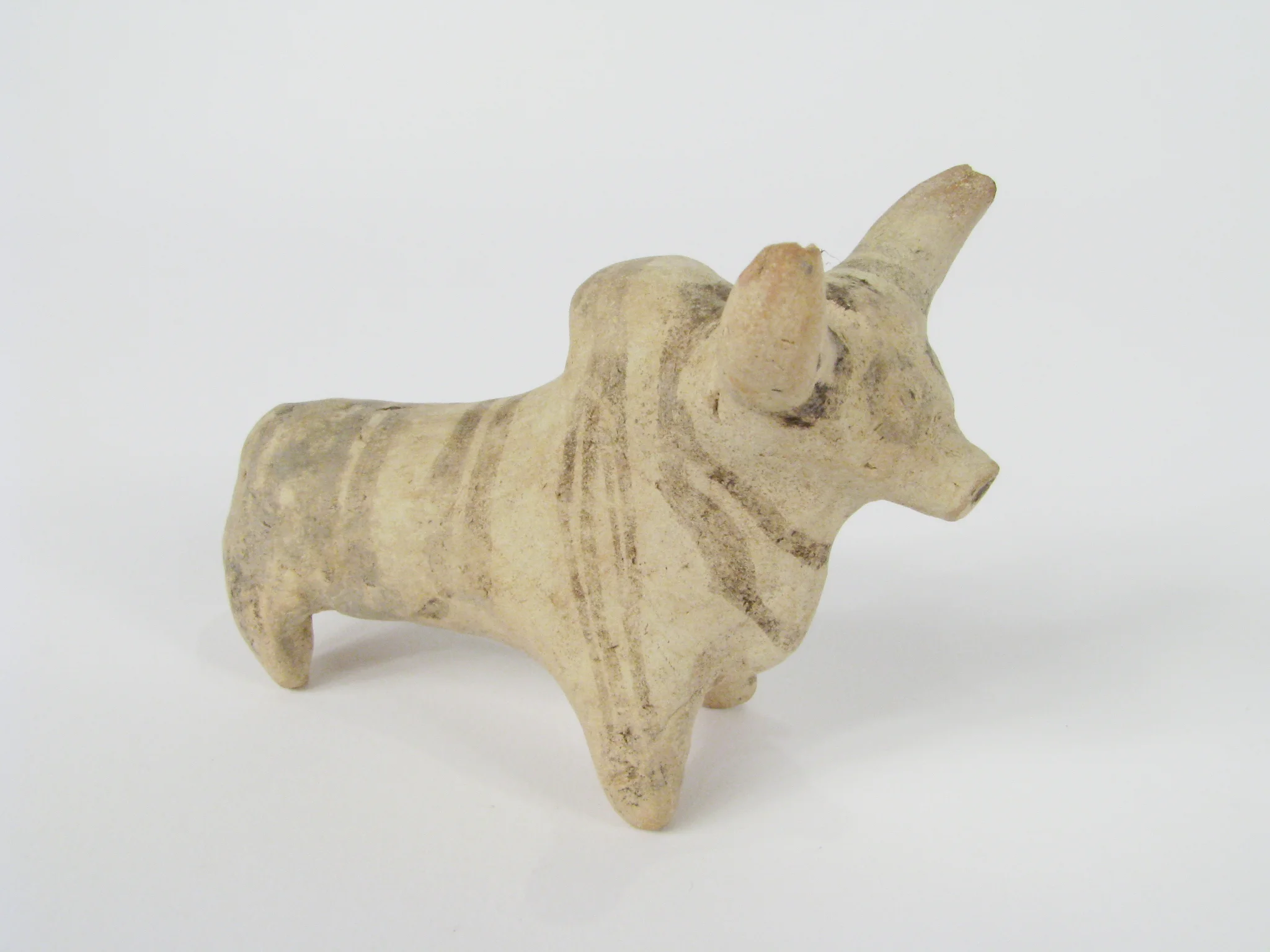
As well as pots, clay idols and animal figures are also characteristic, some of which are solid, others have hollow bodies to avoid them bursting during firing. Much like the depictions on the pots, animal figures included bulls, pumas, birds, rams, goats, and fish.
And what does their script tell us about them and their world? At present this remains a mystery. We have no Rosetta Stone for the Indus people and their language, however, some small steps forward are being made and with only 10 percent of the area excavated, it may not be too far off before we hear from these ancient people more directly.
Guy Earl-Smith Art & Antiquities
Australia’s only boutique antiquities and tribal art auction house.
Since 2000 A.D.
We run several auctions annually. To consign works of art for an auction please contact us on the addresses below.
Contacts
Guy Earl-Smith