
Sumba's Stone Tombs
Only a short 800km off the northwest of Australia’s Kimberly coast lies the Indonesian island of Sumba. The tradition of megalithic burials is one that survives from the Neolithic and Bronze ages and it is one of the few places in the world where it continues.
Only a short 800km off the northwest of Australia’s Kimberly coast lies the island of Sumba.
A part of Indonesia’s East Nusa Tenggera province, Sumba’s geography is unlike the wild volcanic islands to its north. In places it more resembles its neighbouring island of Timor with its rugged mountains and hilltop villages.
In other areas, it contains open grasslands over rolling hills. It is in these regions were the pre-harvest fertility ritual of the Pasola takes place – a ritual spear or lance battle, with villagers fighting in violent confrontations from horseback that result in the occasional death.
Local arts are characterised by naturally-dyed and handspun ikat fabrics, carved timber spears used in the Pasola, elegant bamboo and thatched-roof houses with almost vertical spires in the centre, and most spectacularly, megalithic tombs.
The tradition of megalithic burials is one that survives from the Neolithic and Bronze ages – and through Portuguese and Dutch colonial administration – and is one of the few places in the world where it continues.
That the isolated Sumba is not really on any tourist path may be one reason that little is known about the carvings on these tombs and our knowledge about them is only recently acquired. This isolation has meant that traditional arts have remained quite intact.
The funerary rituals, of which the megaliths are a part, are still carried out today mostly for the rich villages or the nobility. Enormous stone blocks weighing anything from a few hundred kilograms up to more than twenty tons are dragged, sometimes great distances to construct the mausoleums.
There are several styles of tomb. The stones may be carved as flat table-style tombs or a flat stone top sitting on a single stone pillar or several circular or square pillars.
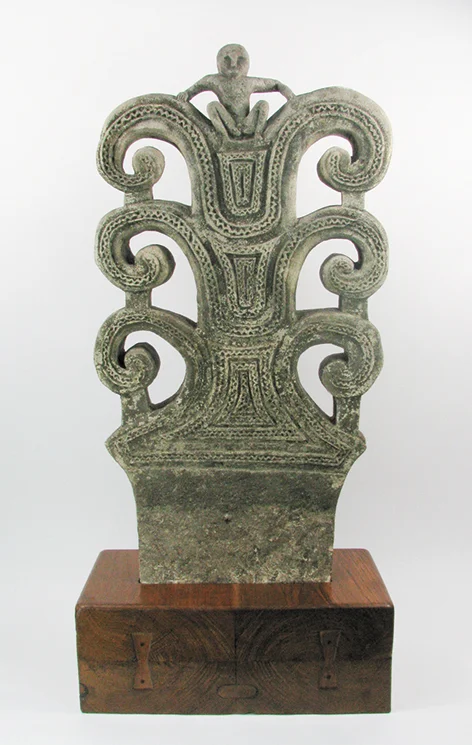
Some of the more elaborate tombstones (such as that pictured below) display curved arms spreading out in a geometric pattern from a central stem, often with a small ancestor figure carved in the centre of the peak. One face of these tombstones often contains another geometric relief carved into the stone.
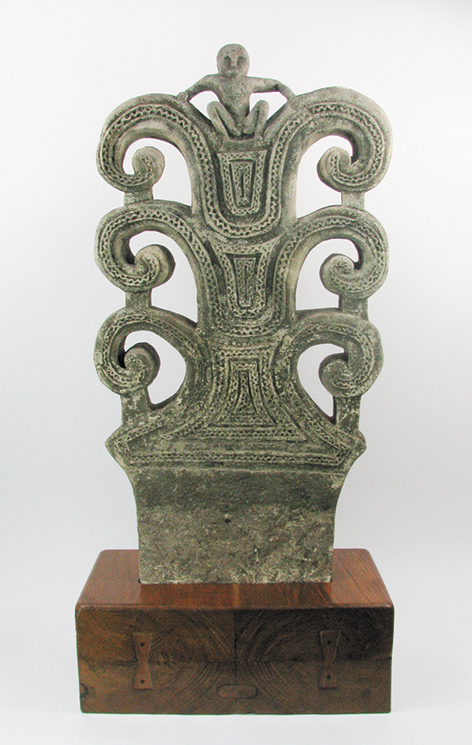
A Sumba Stone Sculpture (penji) 103 x 47cm $1500
The construction of the tombs still holds several clear social benefits:
Most obviously the tomb is a clear image of power for those who built it. Building such a structure for a clan member helps create greater credibility and standing in the community, as such it can be a useful negotiating tool by those that build the tomb when it comes to, for example, organising marriages for their sons and daughters.
The act of working together for an important common goal appears to be another benefit because building such large structures requires a clan effort, not individual effort, and the process helps strengthen relationships, stability and power structures within clans.
In the past when the Sumba society was more violent that it is today, there was an added benefit that tomb-building enhanced inter-clan relationships through combined building effort. This would have helped in resolving disputes between clans and in establishing inter-clan alliances.
References
This site shows how stones are transported and a provides a selection of other megalithic tombs.
For a detailed examination of the tombs see the PhD submission by Ronald Adams, Simon Fraser University.
The Magic Flute Stopper and other tales from PNG
It is not often that an Oceanic artwork trumps the big African art names at Sotheby’s in Paris, but it did in 2012 when €1.4 million was paid for a Biwat flute stopper from PNG. I suspect that many of the African bidders at that sale had never heard of the Biwat – as opposed to the Fang, or the Kuba, or the Dogon – and maybe didn’t know what a flute stopper actually was, so let me explain.
by David Said
It is not often that an Oceanic artwork trumps the big African art names at Sotheby’s in Paris, but it did in 2012 when €1.4 million was paid for a Biwat flute stopper from PNG. I suspect that many of the African bidders at that sale had never heard of the Biwat – as opposed to the Fang, or the Kuba, or the Dogon – and maybe didn’t know what a flute stopper actually was, so let me explain.
New Guinea society and religion is quite different from other tribal cultures. The social structure is flat and democratic, and the population fragmented. There are more than 800 distinct languages and people tend to live in villages, then in clans within villages. There are almost no hereditary chiefs and status had to be earned in one’s own lifetime. In many groups, individual status is judged by how much wealth one gives away, not by how much one keeps.
New Guineans were traditionally animists and ancestor worshipers, and because their small social groups were surrounded by a hostile environment where a drought, fire or an enemy raid could wipe out your entire world, great emphasis is placed on controlling the spirits of ancestors and of nature to protect against these disasters. As a result, outside the skills of day-to-day technology, almost all knowledge was concentrated on how to control these spirits.

The majority of New Guinea art springs from this source – statues, masks and other artworks are primarily carved as temporary homes for the spirits, who are summoned or enticed to live in them while the ceremony or ritual takes place. In contrast to Africa, where secret society masks and symbols were stored and treasured, New Guinea art was quite often burned after the ceremony to destroy traces of the dangerous spirits that had lived in it, and to let their power drain back into the earth.
Along the Sepik, PNG’s river of art, one common way of proving that the spirits were indeed attending ceremonies was to provide them with a voice, and this was the function of the sacred flute, called wusear in the Biwat language. The flutes themselves were ridiculously simple – just a bamboo tube blocked or stopped at the bottom. They were played by blowing across the opening, like a bottle neck, to produce one note only, and always played in pairs to perform plaintive two note melodies. When the flute was playing, usually out of sight behind a screen, the initiated and the uninitiated alike believed that the spirits were present.
The bamboo pipes probably had a short life, but the stoppers were often kept and reused for many more ceremonies. The popular theory is that because they had the power to produce the voices of the spirits, the flutes had to be protected against evil spirits, hence the protective carving on the stoppers. In fact, John Friede, who once owned the world's largest private collection on of New Guinea Art, has a more convincing theory, which is that the bamboo tube was just that, a bamboo tube, but the real essence of the power of the spirit was incorporated into the elaborately carved stopper which actually represented the spirit voiced by the flute. Certainly, if one regards carvings as abodes for spirits, this makes perfect sense.
So much for the flute stoppers – now for the Biwat, who Margaret Mead confusingly named the Mundugumor. They live on the Yuat River which flows into the Sepik system. The Biwat/Mundugamor are famous for hoodwinking Margaret Mead by making up all sorts of fairy stories about themselves to entertain her. The Yuat river was also relatively accessible by canoe from the Government Control Post at Angoram on the Middle Sepik, and was therefore explored by anthropologists and collectors, converted by missionaries and cleared out of most old artefacts a long time ago. In fact, Margaret Mead stated that the flute ceremonies were abandoned by 1930, so there are very few wusear flute stoppers around. That’s one reason why they are so expensive.
Add to this scarcity their power and beauty, and it is easy to see why they attract high prices at any auction, even without the embellishment of the cassowary feathers and shell valuables. In fact, it seems quite likely that the figures were stored stripped bare of ornaments for storage and only dressed up for ceremonies. One excellent example, of which only the wooden figure survived, was sold by Sotheby’s in 2011 for almost €290,000. By contrast, the stopper sold in 2012 achieved 5 times that price, and it is interesting to ask why.
The record-breaking example was, of course, fully dressed with exception of the human hair beard, which seems to be missing in almost all collected examples and a missing nose decoration. It is undoubtedly a superb carving. The aggressive stance of the spirit figure, the staring shell eyes, the extravagant head dress of cassowary feathers and the lavish ear decorations of shell valuables clearly proclaim its importance and power, but it is its watertight provenance that stakes its claim to a record price. It almost certainly originated from the Museum für Völkerkunde in Berlin, then owned by two generations of the Speyer family before being acquired by the famous Dutch collector Louis Lemaire, and passed down to the vendor, his granddaughter.
When they secured this masterpiece, the new owners, be they an individual or a museum, purchased the equivalent of a Ruebens or a Goya of the world of Oceanic art at a fraction of the cost of a European masterwork. The rest of us will just have to keep scouring the auction sales while we search for that once in a lifetime piece of New Guinea art.
A version of this article first appeared in David Said’s blog, In Praise of Tribal Art. Copyright David Said, February 2016.